A team of Japanese, South African, and Italian astronomers recently found that there is a massive region around the center of the Milky Way that is devoid of young stars.
The Milky Way is a spiral galaxy, and the Sun is almost 26,000 light-years from the center in one of its spiral arms. Measuring the distribution of stars within the galaxy is very important in understanding how our galaxy formed and evolved.
Young, pulsating stars called Cepheid Variable stars, or Cepheids for short, are the perfect candidate for this. They are between 10 and 300 million years old, younger than our Sun at 4.6 billion years old, and pulsate in their brightness in a repeating cycle. As this pulsation time is related to its luminosity, astronomers can monitor them to determine their actual brightness; after comparing this with the brightness as seen from Earth, a distance can be determined.
Finding these stars is difficult as the center of the galaxy is full of interstellar dust that obscures the light and hides many stars from view. Using near-infrared observations from the South African Large Telescope (SALT), the team was able to see past the dust; to their surprise they found hardly and Cepheids around a region about 1,000 light-years wide from the core of the galaxy.
The recent findings suggest that the extreme inner disk has virtually no young stars and that no significant amount of star formation has occurred in this area for hundreds of millions of years. The chemical makeup and movement of the Cepheid Variable stars are guiding the team in understanding the formation of the galaxy.
Mostly Cepheids have been used to measure distances of objects in far off in the universe, but this new study shows that the same technique can be used in revealing information a lot closer to home.
To know more about the research, click here.
In a few weeks, scientists could be one step closer to understanding fundamental questions about the origins of our planet and the human race; from an asteroid that could threaten to destroy us.
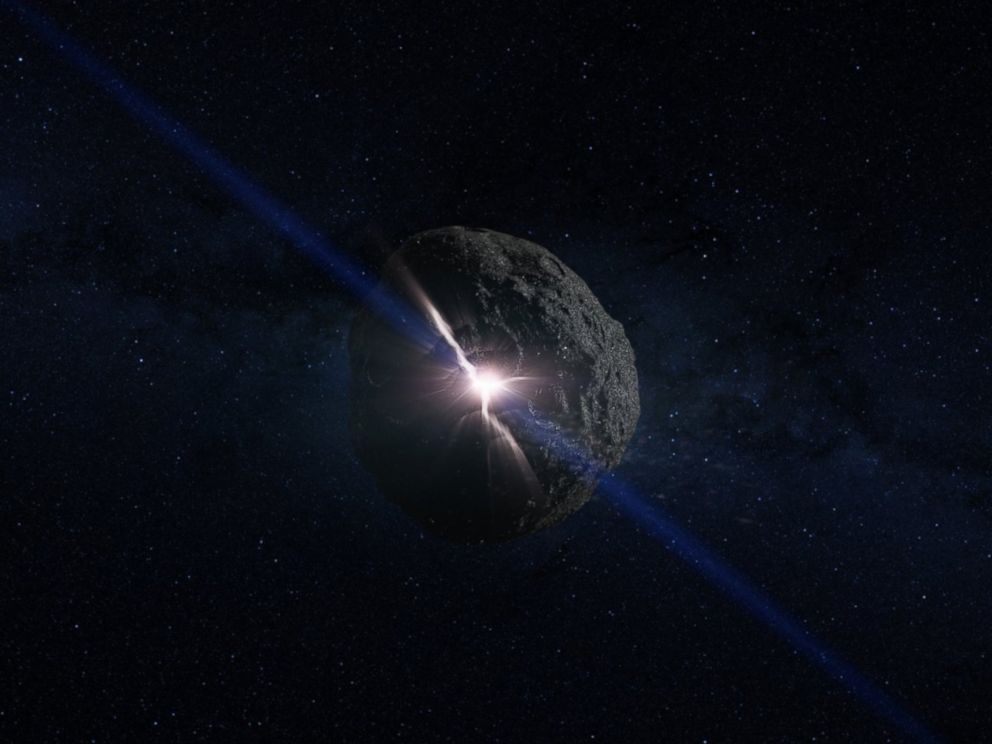
The OSIRIS-REx Mission, headed by NASA and the University of Arizona, plan to launch an unmanned spacecraft on September 8 in the efforts to reach Bennu, a large near-Earth asteroid in August 2018.
The spacecraft will survey Bennu until a small vacuum-like device is capable of hovering above the asteroid and sucking up somewhere between 60 and and 400 grams of "gravel and soil" to bring back to Earth in the year 2023, according to Dante Lauretta, a professor of planetary science and cosmochemistry at the University of Arizona's Lunar and Planetary Laboratory, and the principal investigator on the OSIRIS-REx mission.
As a near-Earth asteroid, Bennu once existed in what he described as a main asteroid belt, located between Mars and Jupiter. There, it was likely dislodged by a gravitational pull towards Saturn, sending it closer to us. The asteroid could indeed strike Earth, and cause tremendous destruction.
Bennu has a one in 2,700 chance of hitting Earth, and such an event wouldn't take place for 150 years. People living in the year 2135 would know whether the asteroid posed a threat to hit Earth. Bennu would enter a "keyhole" located between the Earth and the moon that would send it in the direction of Earth.
A one in 2,700 chance isn't too insignificant. But by the time it would strike, we would likely have the technology to destroy Bennu.
To read more, click here